On Counting Trucks
Counting trucks in the USA is
one of the things we enjoy doing during our long road trips there. Not just any
trucks, though; only those from specific companies. Not just anyone gets to be
part of the game! :-)
It all began in 2002, when my wife and I set out on a trip from Washington DC to
Gettysburg, then on to New Orleans, and finally back to Washington via Florida
and South Carolina - though not all in one go. Time and again, we encountered
trucks belonging to the company J. B. Hunt. We joked that it was probably the
same truck following us the whole way, because we kept seeing it at rest stops,
at the motels where we stayed, and also out on the interstates - the type of
road we used most on that trip. On subsequent trips, we continued to keep an eye
out for J. B. Hunt trucks, and we kept seeing them, even though we weren't
actually counting them back then.
In 2010, my son Tim and I took a trip together through the western United
States, and I told him about our little joke. On that trip, however, we didn't
see a single J. B. Hunt truck. Instead, we saw several freight trains loaded
with J. B. Hunt containers. The absence of J. B. Hunt trucks led us to look at
other companies, primarily for some reason, Knight. At first, we assumed they
only operated refrigerated trucks, but we later learned otherwise. We saw quite
a few of them during the first leg of the trip. Later on, we also started
noticing trucks from the company Werner (a name we thought sounded quite good)
and Swift - of which there were a great many. In 2012, we added Schneider to the
list, and in 2013, C. R. England joined as well. At the same time, we started a
competition to see which trucks we spotted the most. In 2014, it was Swift,
except in the area around Dallas, where Werner clearly outnumbered the others.
This surprised us a bit, as Swift is a significantly larger company than Werner;
however, it turned out they had a logistics center less than a mile from the
hotel where we were staying, which explained it.
We have counted trucks on every trip since, and 2026 was a good year with a
record breaking number. But now, let’s take a
look at the eight companies we count. The numbers mentioned can be
outdated as I have checked them since I wrote the original article in 2015.
Maybe I will do that some time.
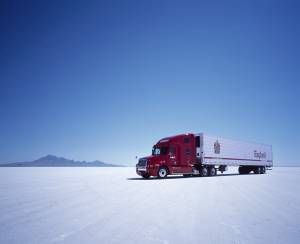 C.
R. England Trucking Company is a rather old addition to the list of
companies whose trucks we monitor; however, and is actually the oldest of the
eight, having been founded as far back as 1920. Established by Chester Rodney
England, the company is headquartered in Salt Lake City, Utah. During World War
II, England purchased Mexican bananas that crossed the border at El Paso, Texas,
and distributed them throughout Utah. When his sons returned from military
service, they assisted in transporting these bananas, while also hauling
potatoes from Idaho to Texas. As bananas from Central America became available,
the Mexican variety lost its appeal; consequently, England shifted focus,
turning to the transport of other fruits and vegetables from California and
Arizona to Utah.
To this day, C. R. England is best known for refrigerated transport, operating
one of the largest fleets of refrigerated trucks in the United States. The
company claims to be the world’s largest temperature-controlled carrier, though
it also transports dry freight. It remains under the leadership of the England
family, now in its third and fourth generations. The company does not disclose
the exact number of tractors and trailers in its fleet.
 Swift
Transportation was founded by Carl Moyes in 1966.
Before striking out on his own, he had worked as a driver for C. R. England
during the 1940s and 1950s; however, in the late 1950s, he and his wife, Betty,
started a small trucking company in Plain City, Utah -
- the very place where C. R. England came from. The company was named B & C
Truck Leasing. When their son graduated from university, they relocated the
business to Phoenix, Arizona. Together with their sons, Jerry and Ronald, they
established a company called Common Market. Initially, the firm transported
imported steel from the ports of Los Angeles to Phoenix, while hauling cotton
from Arizona in the opposite direction. At one point, Common Market acquired the
transport division of the meatpacking company Swift & Co., and they decided to
adopt that name for their own transport business. By 1984, revenue had grown to
$25 million, and the company continued to expand.
Today, the company is a public corporation and the largest trucking company in
the United States. It employs approximately 18,000 people and operates 12,300
tractors. In addition, there are another 3,900 privately owned tractors
operating under the Swift logo. The company possesses 48,000 trailers and
approximately 4,500 containers. Currently, the company's revenue is approaching
$5 billion.
 Like
Swift, Knight Transportation is also based in Phoenix, Arizona. The
company was founded in 1990 by two pairs of brothers who were also cousins:
Randy and Gary Knight, along with Kevin and Keith Knight. All four worked for
Swift Transportation, where Gary was a co-owner until Jerry Moyes bought him
out. The Knight family also originally came from from Plain City, Utah. Much
like Swift, Knight began by transporting goods from Phoenix to Los Angeles, and
other cargo on the return trip. At the time, the company had only 4 or5 trucks
and a single service center in Phoenix.
Today, the company has 4,000 employees, approximately 4,500 tractors, and around
9,000 trailers—a large portion of which are refrigerated units. Knight is now a
public company with revenue approaching $1 billion. They currently operate 46
centers across the United States, in addition to 13 sales offices. As shown in
the image, their trucks are red; however, this does not apply to their
refrigerated units, which are blue.
We were quite dismayed to discover, following our vacation in 2018, that Knight
had actually merged with Swift - meaning, at the ownership level at least, they
are once again the same entity. Nevertheless, we continue to count them
separately, provided they are still operating the "authentic" trucks. 2026, was
not a godd Knight year though with only 27 counted trucks on a four week
road-trip.
 Schneider
National is the largest privately owned transport company in the United
States. The company was founded way back in 1935, when Al Schneider sold his car
to buy his first truck. Its headquarters are located in Green Bay, Wisconsin
(known to American football fans as the home of the Green Bay Packers). Al was
succeeded as CEO by his son. Today, the son has been succeeded by Christopher
Lofgren, but the Schneider family still owns the company.
The firm employs 11,000 drivers, in addition to other staff. They have 10,000
tractors and 31,000 trailers on U.S. roads, transporting more than 16,000 loads
per day. Beyond the United States, they also operate in Canada, Mexico, and
China, where they maintain their own facilities—as well as in a number of other
countries where they do not have their own centers. Schneider’s client list
includes two-thirds of all Fortune 500 companies. In 2005, revenue exceeded $3
billion, and it has not decreased since. That same year, Schneider was the
fourth-largest transport company in the U.S.
 Werner
Enterprises also ranks among the top 10 largest trucking companies in the
United States, with revenue in the neighborhood of $2 billion. The company was
founded by Clarence L. Werner in 1956, at the age of 19, in Omaha, Nebraska,
where it remains headquartered today. Sixty years later, Werner continues to
serve as Chairman and an executive of the company (alongside two of his sons).
His other two children (a son and a daughter) were previously involved in the
business and now serve on the Board of Directors. Werner transports freight
across the United States, Canada, Mexico, Asia, Europe, and South America, and
maintains offices in the U.S., Australia, and China.
Currently, the company operates 7,300 tractors and nearly 24,000 trailers, in addition to contracting with 11,500 independent owner-operators to transport Werner’s freight.
 And
now, the company that sparked the entire interest in trucking firms in the
United States. J. B. Hunt Transport Services was founded in 1961 by
Johnnie Bryan Hunt in Lowell, Arkansas, where the company is still
headquartered. When Hunt started the business, it consisted of five trucks and
seven trailers - all of which were refrigerated units. By 1984, the company had
grown to include 550 tractors, 1,050 trailers, and 550 employees. At that time,
it ranked 80th on the list of the largest transport companies in the U.S.
Today, it is one of the absolute largest transport companies in the United
States, with over 19,000 employees. It operates 12,000 tractors and 47,000
trailers and containers. Annual revenue has now surpassed $10 billion; however,
the majority of both revenue and profit is derived from activities other than
traditional trucking. Since 1989, J. B. Hunt has transported containers via
rail; today, this segment accounts for 61% of revenue and 77% of profit. J. B.
Hunt maintains a long-term agreement with BNSF Railway, the second-largest
freight railroad in the United States. Revenue from trucking operations, not
including Intermodal) stands at approximately $4 billion.
Two more companies, both included in the competition in 2018.
 Estes
Express Lines is, notably, an LTL carrier, unlike the companies mentioned
above. LTL stands for "Less Than Truckload," meaning that customers do not need
to fill an entire truck; instead, they can ship smaller quantities, such as a
single pallet of goods. They operate in a manner somewhat similar to parcel
delivery services like DHL, FedEx and UPS, though LTL carriers handle larger
"packages" - typically weighing between 500 kg and 10 tonnes. In this process,
cargo is collected from customers by smaller vehicles and transported to a
central hub. There, it is transferred onto large trucks, which carry it to
another hub; from that point, smaller vehicles deliver the shipment to the final
recipients. Estes Express Lines was founded by W.W. Estes back in 1931 and
remains owned by the Estes family. The company is headquartered in Richmond,
Virginia. Today, Estes is the largest LTL carrier in the United States, though
it also provides Full Truckload services. Estes has 16,000 employees, 214
terminals, 6,700 tractors, and 30,000 trailers. Its annual revenue is
approximately 2.5 billion dollars.
 Saia
was founded in 1924 by Louis Saia in Houma, Louisiana; the company is now
headquartered in Johns Creek, Georgia. Saia was originally a vegetable
wholesaler but discovered that there was more money to be made in transporting
vegetables than in selling them. Having undergone various acquisitions and
divestments, Saia now operates as an independent entity. Like Estes, Saia is
primarily an LTL (Less-Than-Truckload) carrier, though, following the
acquisition of other companies, it now also handles Full Truckload (FTL)
shipments. In 2023, following the bankruptcy of the parent company, Saia
acquired 17 terminals from YRC (of which it was previously a subsidiary). The
company employs 10,500 people and operates approximately 165 centers across the
United States. While the company does not disclose the exact number of tractors
and trailers in its fleet, it generates an annual revenue of approximately $2.3
billion.
And the result of the 2026 "competition"
| J. B. Hunt Transport Services | 158 |
| Swift Transportation | 107 |
| Schneider National | 106 |
| Saia | 81 |
| Este Express Lines | 80 |
| Werner Enterprises | 73 |
| C. R, England Trucking Company | 33 |
| Knight Transportation | 27 |